
01 / Agency field notes
Write the formula and the denominator together
For this guide, billable utilization is billable hours divided by available hours, multiplied by 100. Available hours are the scheduled working hours for the people and period being measured, after the exclusions you explicitly choose. Billable hours are time assigned to client work under the agreed billing classification.
Decide how holidays, leave and part-time schedules affect availability. Record the decision beside the report. Do not silently subtract internal meetings from one team's denominator while leaving them in another. The resulting percentages would look comparable while measuring different things. Keep the same time period, people and units in both sides of the formula.
02 / Agency field notes
Work through a small example
Imagine an illustrative team with 160 available hours in one week after its stated leave and holiday adjustments. It records 120 billable hours and 24 non-billable hours, with 16 available hours not accounted for in the example. Billable utilization is 120 ÷ 160 = 75%. Total recorded workload is 144 ÷ 160 = 90%.
The remaining 16 hours are a question, not a conclusion. They could reflect missing entries, available capacity or another classification issue. Confirm the records before assuming that the team was idle. Similarly, the 24 non-billable hours may include essential planning, training or business development rather than avoidable work.
| Measure | Calculation | Result |
|---|---|---|
| Billable utilization | 120 billable ÷ 160 available | 75% |
| Recorded workload | 144 recorded ÷ 160 available | 90% |
| Unaccounted capacity | 160 available − 144 recorded | 16 hours |
03 / Agency field notes
Keep utilization separate from profitability
An hour can be classified as billable without creating a separately charged line on a fixed-fee invoice. It can also be billed at a rate that does not support the delivery cost. Utilization tells you about the allocation of time; it does not tell you whether the agreed fee produces a good contribution or whether the client has paid.
Consider two illustrative people who each record 30 billable hours against 40 available hours. Both show 75% utilization. If their work belongs to projects with different fees, scope overruns or direct costs, the financial results can be very different. Review project contribution and billing status alongside utilization instead of asking one percentage to answer all three questions.
04 / Agency field notes
Understand role differences before setting targets
A delivery specialist, an account lead and an agency founder have different responsibilities. Sales conversations, supervision and internal quality work may be necessary parts of one role and a smaller part of another. Applying one target to everyone can encourage people to relabel work instead of improving the underlying operation.
Set expectations from the role's actual responsibilities and the agency's capacity plan. Explain which work belongs in each category. Review the classification when responsibilities change. A new manager spending time helping others deliver is not automatically underperforming because their own billable percentage falls.
05 / Agency field notes
Diagnose low and high readings differently
A low reading can indicate weak demand, work blocked by missing inputs, uneven allocation or incomplete time capture. Start by distinguishing these causes. The right response to missing access is different from the right response to an empty pipeline.
A high reading can show strong demand, but persistent readings near or above planned capacity deserve investigation. Check overtime, the accuracy of availability and whether important internal work is being squeezed out. A target that leaves no room for review, learning or unexpected issues may create a brittle delivery plan.
| Pattern | Check first | Possible action |
|---|---|---|
| Low utilization, complete records | Is work available but blocked? | Resolve input or approval dependencies |
| Low utilization, sparse records | Are entries missing or misclassified? | Reconcile the period before judging demand |
| Uneven team utilization | Can work move between suitable people? | Review skills, ownership and allocation |
| High utilization with late delivery | Is the workload greater than planned capacity? | Reprioritise commitments and inspect remaining effort |
06 / Agency field notes
Use both a backward and a forward view
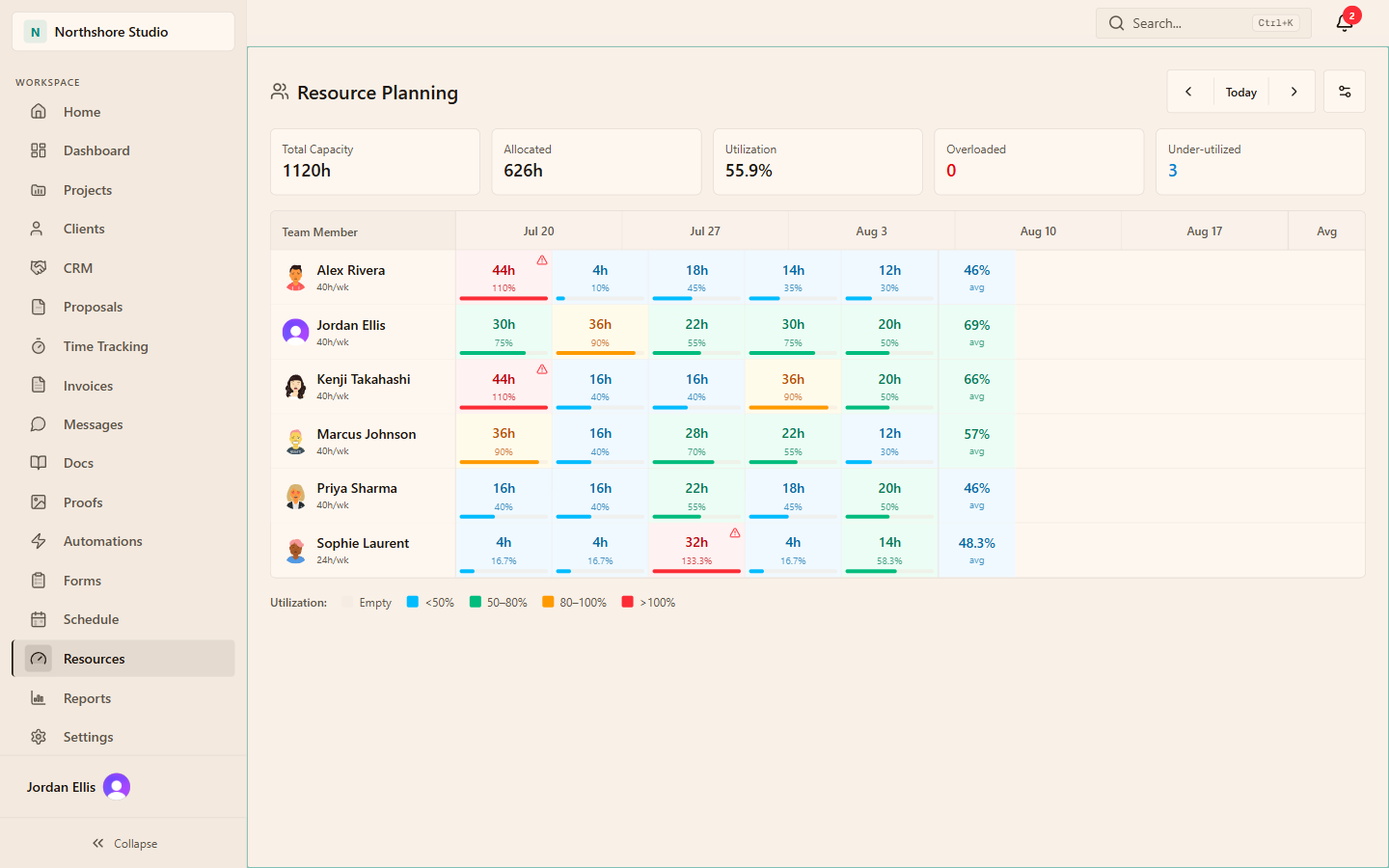
Time entries explain what happened. A capacity plan describes the work expected next. Review both at a regular delivery meeting: actual utilization can reveal an estimating issue, while planned allocation can show a future overload that last week's timesheet cannot.
Keep forecasts clearly labelled. A plan with 120 assigned hours is not the same as 120 completed billable hours. Ask project owners to update remaining work and dependencies before using the plan to accept another deadline. Flowboard brings time records and resource planning into the same workspace; the forecast still depends on current human estimates.
07 / Agency field notes
Create a review people can trust
Use the report to discuss work, not to rank people without context. Start with completeness and definitions, then examine trends and exceptions. Ask whether the team has the right assignments, clear requirements and enough time to deliver responsibly.
Keep a short record of decisions: a blocked project needs client input, a recurring internal task needs a better process or an upcoming commitment needs another delivery option. Review whether those decisions changed the situation. A percentage is useful when it leads to a better allocation decision, not merely when it moves upward.
THE PRACTICAL DETAILS
Questions, answered.
What is a good billable utilization target?
It depends on role responsibilities, availability definitions, commercial model and the internal work the business requires. This guide deliberately provides a calculation example rather than a universal target.
Should leave be included in available hours?
Choose and document a consistent policy. Many operational views adjust for planned leave and holidays to reflect working availability. The essential point is that comparisons must use the same stated definition.
Can utilization exceed 100%?
Yes, if recorded billable hours exceed the available hours in the chosen model. Investigate overtime, an incorrect denominator or data problems. Do not automatically treat an over-capacity result as a sustainable success.
Do fixed-fee project hours count as billable?
They can under a consistent classification for client delivery, even when the fee is not invoiced by the hour. Keep that classification separate from the question of which time entries are eligible for an hourly invoice.
Does low utilization mean the team is unproductive?
No. It may reflect essential internal work, blocked client work, missing records or insufficient demand. Review the cause and the role before drawing a conclusion about performance.